


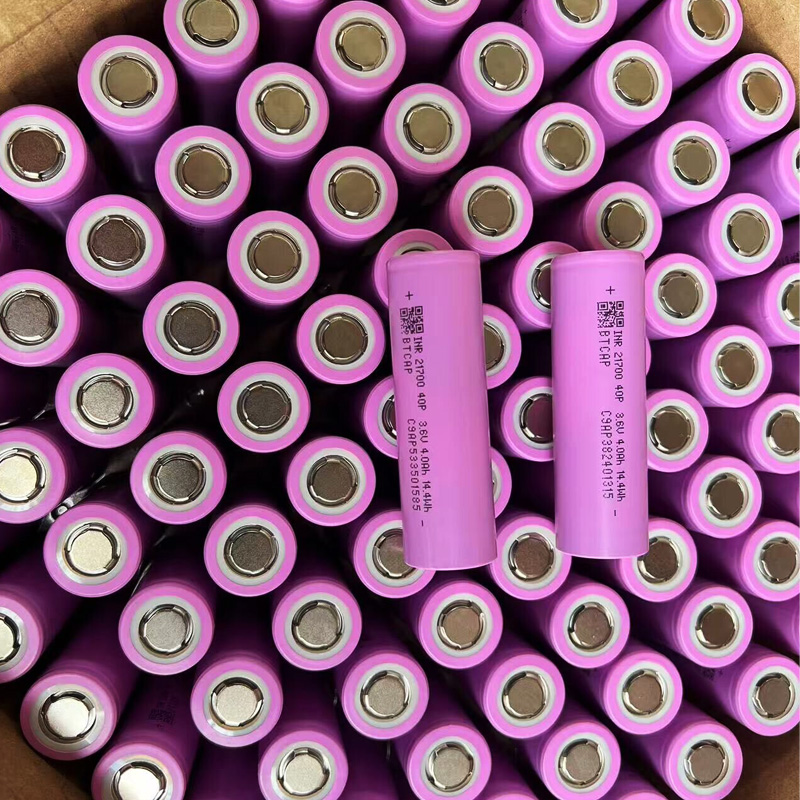
Tabless Lithium Cell
| Model | INR21700-40P |
| Rated Capacity | 4000mAh |
| Minimum Capacity | 3900mAh |
| Nominal Voltage | 3.6V |
| Max. Charge Voltage | 4.2V |
| Min. Discharge Voltage | 2.5V |
| ACIR 1kHz | ≤5mΩ @25±3℃, 3.5V±0.05V |
| Standard Charge Current | 2.0A(0.5C) @25±3℃ |
| Max. Charge Current | 8.0A(2.0C) @25±3℃ |
| Rated Discharge Current | 2.0A(0.5C) @25±3℃ |
| Max. Continuous Discharge Current | 70A(17.5C), 2.5V, T: 75℃ recommeded, T: 80℃ Max. |
| Operating Ambient Temperature | Charge: 0℃~45℃ |
| Discharge: -40℃~60℃ | |
| Operating Surface Temperature | Charge: 0℃~45℃ |
| Discharge: -40℃~80℃ | |
| Storage Temperature Range | 1 year, -20℃~25℃ |
| 3 months, -20℃~45℃ | |
| 1 month, -20~60℃ | |
| High Rate Cycling | ≥400 cycles, 75℃ cut-off |
| Standard Cycle Life | ≥700 cycles, 25±3℃ |
| Cell Weight | ≤69.0g |
| Cell Dimension | Diameter: 21.65±0.10mm |
| Height: 70.50±0.10mm |
Tabless battery technology represents a significant architectural shift in cylindrical lithium-ion cell design, moving away from traditional "tabs" toward a continuous contact system. In a standard battery, a small metal tab connects the internal electrode to the external casing, creating a bottleneck for electrical flow and a primary source of heat. In contrast, "tabless" designs utilize the entire edge of the electrode foil to conduct current, dramatically reducing internal resistance and optimizing thermal management.
The industry gained major momentum with the Tesla 4680 Tabless Battery, which proved that larger form factors could maintain high performance without overheating. By removing the traditional tab, the 4680 Tabless structure allows electrons to travel a much shorter distance, resulting in faster charging speeds and higher power output. This breakthrough has paved the way for smaller, high-power formats, most notably the advanced 21700 battery cell variants now entering the market.
Leading manufacturers are applying this logic to specialized high-performance models like the Reliance INR21700 battery series. For instance, the INR21700-45D, INR21700-JP40, INR21700-40PL, INR21700-RS40, and INR21700-40XG leverage this architecture to provide extreme discharge rates for professional power tools and racing drones. Similarly, high-capacity versions like the INR21700-50PL, INR21700-50D, INR21700-RS50, and INR21700-50XG utilize tabless connections to balance high energy density with cooler operating temperatures. By eliminating the thermal constraints of traditional tabs, these cells offer a more reliable and efficient energy solution for the next generation of electric mobility and industrial applications.
The industry gained major momentum with the Tesla 4680 Tabless Battery, which proved that larger form factors could maintain high performance without overheating. By removing the traditional tab, the 4680 Tabless structure allows electrons to travel a much shorter distance, resulting in faster charging speeds and higher power output. This breakthrough has paved the way for smaller, high-power formats, most notably the advanced 21700 battery cell variants now entering the market.
Leading manufacturers are applying this logic to specialized high-performance models like the Reliance INR21700 battery series. For instance, the INR21700-45D, INR21700-JP40, INR21700-40PL, INR21700-RS40, and INR21700-40XG leverage this architecture to provide extreme discharge rates for professional power tools and racing drones. Similarly, high-capacity versions like the INR21700-50PL, INR21700-50D, INR21700-RS50, and INR21700-50XG utilize tabless connections to balance high energy density with cooler operating temperatures. By eliminating the thermal constraints of traditional tabs, these cells offer a more reliable and efficient energy solution for the next generation of electric mobility and industrial applications.
| Tabless Models | Reference |
| INR18650-JP30 | 18650 Tabless Battery |
| INR18650-30PL | Tabless 18650 Battery |
| INR18650-30XG | Tabless Battery 18650 |
| INR21700-RS40 | 21700 Tabless Cell |
| INR21700-40PL | 21700 Tabless Battery |
| INR21700-JP40 | Tabless 21700 Cells |
| INR21700-40XG | Tabless 21700 40XG Battery |
| INR21700-40P | Tabless Lithium Cell |
| INR21700-42P | Tabless Li ion Cells |
| INR2170-45D | Tabless 21700 Battery |
| INR2170-50D | Tabless 21700 50D Battery |
| INR21700-50PL | Tabless 21700 |
| INR21700-RS50 | 21700 Tabless |
| INR21700-50XG | 21700 Tabless Cells |
| INR21700-RH60 | Tabless Cells 21700 |
| 4680 Tesla Battery | 4680 Tabless Battery |
The BTCAP 21700 series represents a pinnacle in cylindrical lithium-ion engineering, specifically designed to meet the rigorous energy demands of modern industrial and commercial sectors. As global markets transition toward high-output energy solutions, the BTCAP 21700 battery has become a cornerstone for applications ranging from advanced e-mobility to heavy-duty cordless power tools.
A standout innovation within this lineup is the BTCAP 21700 Tabless architecture. By removing traditional metal tabs and utilizing a continuous contact design, this cell significantly reduces internal resistance and optimizes thermal management. This allows for higher discharge rates and faster charging without the typical heat-related degradation seen in standard formats.
Complementing this high-tech design are the performance-focused models: the BTCAP 21700 40P and the BTCAP 21700 42P. The 40P is engineered for stability and high-current consistency, making it ideal for robotic systems, while the BTCAP 42P offers an increased capacity of 4200mAh for extended runtimes in critical equipment. Together, these cells provide a versatile, professional-grade portfolio that ensures peak efficiency and safety in the most demanding battery pack configurations.
A standout innovation within this lineup is the BTCAP 21700 Tabless architecture. By removing traditional metal tabs and utilizing a continuous contact design, this cell significantly reduces internal resistance and optimizes thermal management. This allows for higher discharge rates and faster charging without the typical heat-related degradation seen in standard formats.
Complementing this high-tech design are the performance-focused models: the BTCAP 21700 40P and the BTCAP 21700 42P. The 40P is engineered for stability and high-current consistency, making it ideal for robotic systems, while the BTCAP 42P offers an increased capacity of 4200mAh for extended runtimes in critical equipment. Together, these cells provide a versatile, professional-grade portfolio that ensures peak efficiency and safety in the most demanding battery pack configurations.


Reviews
There are no reviews yet